National Meeting to Assess the Performance of National Retirement Fund Agencies: Mr. Abdelhak Saihi Sets the Framework for Operational and Strategic Activities to Deliver Effective and Accessible Services, Accelerating Digital Transformation for Retirees and Facilitating Their Access to Services
THE 29 June 2026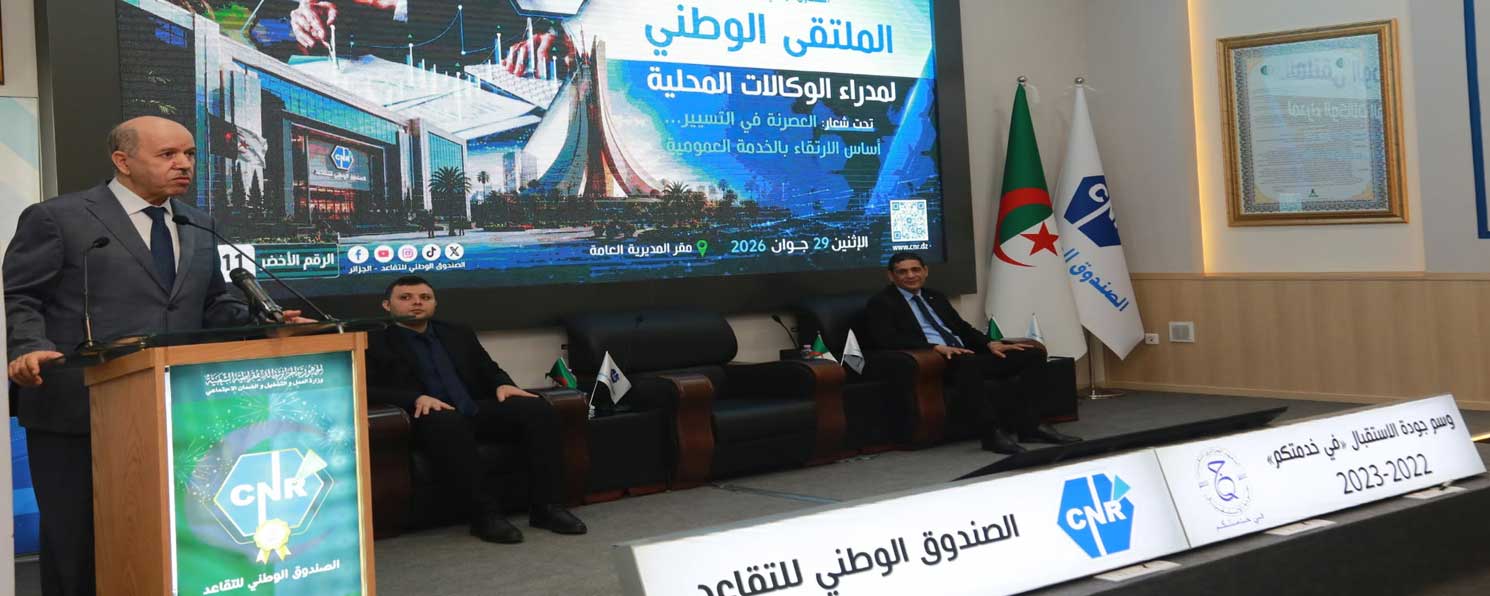
The Minister of Labour, Employment and Social Security, Mr. Abdelhak Saihi, chaired, on Monday, 29 June 2026, at the headquarters of the General Directorate of the National Retirement Fund, the opening ceremony of the National Meeting of the Fund’s Provincial Directors. The meeting was devoted to assessing the activity report and discussing the prospects for the next phase, as part of the continued modernisation of the sector’s facilities and the improvement of the quality of services provided to retirees.
In his opening address, the Minister stressed that evaluation is not merely an opportunity to present results, but rather a highly important mechanism based on two complementary objectives. The first is to assess what has been achieved and what could not be achieved, while analysing the reasons behind the gaps. The second is to develop a corrective and forward-looking action plan to ensure the completion of projects, strengthen performance and achieve the objectives set.
The Minister explained that the National Retirement Fund has made significant progress in implementing its digitalisation process in recent years, considering digitalisation a strategic choice aimed at bringing services closer to citizens, simplifying administrative procedures and reducing the burdens and costs associated with paper-based processing and traditional infrastructure, in line with modern approaches to public administration.
In this context, the Minister stressed the need to accelerate the transition towards remote service delivery by expanding the use of digital applications on smartphones to communicate with retirees, thereby contributing to reducing their visits to the Fund’s offices. He called for the target of reducing visits to service counters by at least 50% before the end of the current year to be achieved.
He also highlighted the importance of deploying modern digital solutions, particularly facial recognition technologies provided by the Fund, which have eliminated the requirement for retirees to submit proof-of-life certificates in order to continue receiving their benefits and pensions. This saves retirees unnecessary effort and safeguards their dignity after many years of service to the nation.
With regard to human resources development, the Minister stressed that investment in human capital is one of the key pillars of reform. He called for young professionals to be empowered and encouraged to assume positions of responsibility, particularly in fields related to modern technologies, while making use of the knowledge and expertise of experienced senior officials, within a framework of intergenerational complementarity serving the interests of service users.
He also stressed the need to rationalise expenditure and establish a culture of sound management, explaining that this should in no way affect retirees’ rights or the quality of public services. Rather, the objective is to eliminate unnecessary expenditure and direct resources towards priorities that have a direct impact on improving performance.
The Minister also called for the establishment of a new administrative culture that places service users at the heart of public service, through simplifying procedures, reducing their need to travel to different offices to the absolute minimum, and promoting the values of good reception, a more humane approach to relations and service quality, as a national and ethical responsibility reflecting the image of public administration.
He stressed that modernising public administration is not limited to digitalising services, but also includes improving employees’ working conditions and providing them with the necessary material and technical resources to perform their duties under the best possible conditions, which in turn has a positive impact on the quality of services provided to users.
In the same context, the Minister emphasised the importance of continuous training as a key pillar for keeping pace with digital transformations and developing professional skills. He called for regular training sessions for staff to enhance their capabilities and improve their professional performance.
At the conclusion of his address, the Minister commended the positive results achieved by the National Retirement Fund in recent years, which have contributed to improving its performance and strengthening citizens’ confidence in its services. He stressed that preserving these achievements requires continued efforts with the same spirit of commitment and responsibility, in line with the orientations of the President of the Republic aimed at consolidating the principles of the social State and establishing a modern, effective and citizen-centred public service, faithful to the values of the 1 November 1954 Revolution and the principles of social justice and solidarity.


