New Digital Projects in the Labour, Employment and Social Security Sector to Be Launched Before the End of December 2026, Serving Citizens
THE 23 July 2026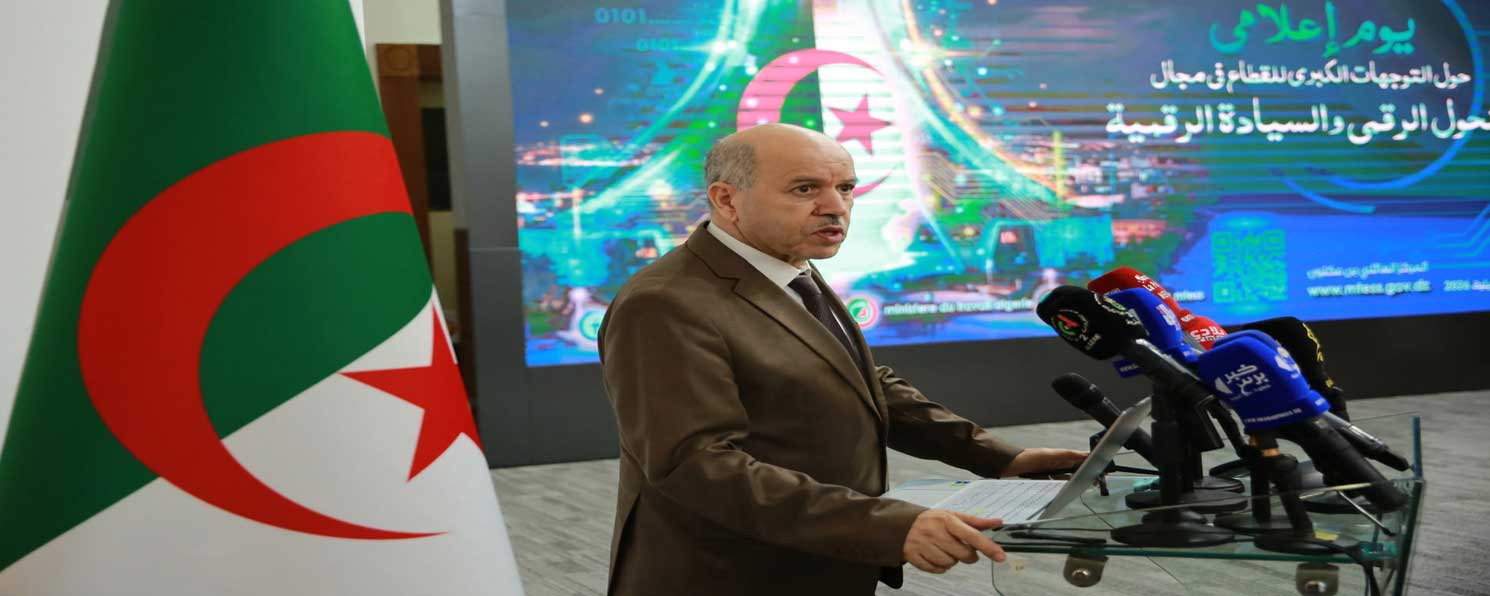
The Minister of Labour, Employment and Social Security, Mr. Abdelhak Saihi, chaired today, Thursday, 23 July 2026, at the Ben Aknoun Family Centre, the opening of the information day entitled: “The Major Orientations of the Labour, Employment and Social Security Sector in the Field of Digital Transformation and Digital Sovereignty”, in the presence of the Secretary-General, the Chief of Staff and senior officials of the sector.
The event was organised as part of the implementation of the State’s strategic orientations aimed at accelerating the digital transformation process, consolidating the principles of digital sovereignty and enhancing the quality of public services, in line with the national vision of building a modern administration based on innovation and advanced technologies.
In his address, the Minister stressed that digital transformation has become an absolute necessity for improving the quality of public services and enhancing support for service users, through the simplification of administrative procedures and the reduction of processing times. He explained that the sector’s digitalisation process is beginning to yield tangible results, with the digital services made available generating broad satisfaction among both citizens and administrative users, thanks to the deployment of electronic platforms that enable numerous services to be completed remotely, thereby reducing the need to travel to different public facilities and easing pressure on service counters.
He added that digitalisation has contributed to enhancing management efficiency by eliminating the need for numerous documents and replacing them with innovative digital services, such as the facial recognition application introduced by the National Retirement Fund, which has simplified proof-of-life procedures for pensioners, in addition to the various digital applications and platforms that have contributed to improving service quality, enhancing transparency and bringing the administration closer to citizens.
In this regard, the Minister stressed the importance of adopting continuous evaluation mechanisms to measure the performance of digital services and ensure their further development in line with citizens’ needs. He noted that reaching 235 electronic services represents an important milestone in the digital transformation process and reflects the efforts made to expand the range of services delivered to users through digital channels. However, these achievements remain insufficient and require intensified efforts through the establishment of a clear roadmap to complete the digital transformation process and increase the number of digital services by at least 50%, according to a defined timetable by the end of December 2026.
The Minister also highlighted the growing importance of artificial intelligence in the development of public administration, stressing that it has become a central component in improving services, simplifying procedures and enhancing performance quality. He further emphasised the need to strengthen the cybersecurity framework and ensure the highest standards of technological protection in order to safeguard personal data and information, protect citizens’ privacy and strengthen trust in digital services.
He called for practical proposals and approaches focused on improving the quality of public services and enhancing user convenience, particularly through bringing together the digital services provided by the various bodies of the sector on a unified digital platform. Such a platform would enable citizens to access integrated digital services remotely, sparing them the inconvenience of travelling to different service counters.
It should be noted that the Labour, Employment and Social Security sector is one of the leading sectors in the field of digitalisation. During the period from September 2025 to June 2026, 28 major digital projects were completed, covering the development of digital infrastructure, the strengthening of cybersecurity, the expansion of interoperability and the launch of new electronic services, in addition to the integration of artificial intelligence applications into a number of processes and services.
Furthermore, 36 digital platforms were established, providing 235 electronic services, while 31 digital services were upgraded and 36 new services launched. This reflects the sector’s effective transition from the digitalisation of procedures to a new phase of digital innovation and sustainable development.
The event also provided an opportunity to present the sector’s digital roadmap through a series of technical presentations delivered by the officials responsible for modernisation and information systems at the Ministry and its supervised entities. The presentations covered the main projects completed, prospects for developing digital services, areas for the use of artificial intelligence, and the strengthening of cybersecurity, with a view to supporting the objectives of the sector’s strategic plan for the 2026–2030 period.
The information day concluded with an emphasis on continuing collective efforts and pooling resources to foster a culture of innovation and modernisation, strengthen the sector’s position among the country’s leading sectors in digital transformation, and contribute to achieving the Sustainable Development Goals while serving citizens in accordance with the highest standards of quality and efficiency.


