Minister of Labour, Employment and Social Security Opens National Evaluation Meeting of Labour Inspection Services and Announces Reform Initiatives for the Inspection Body
THE 19 July 2026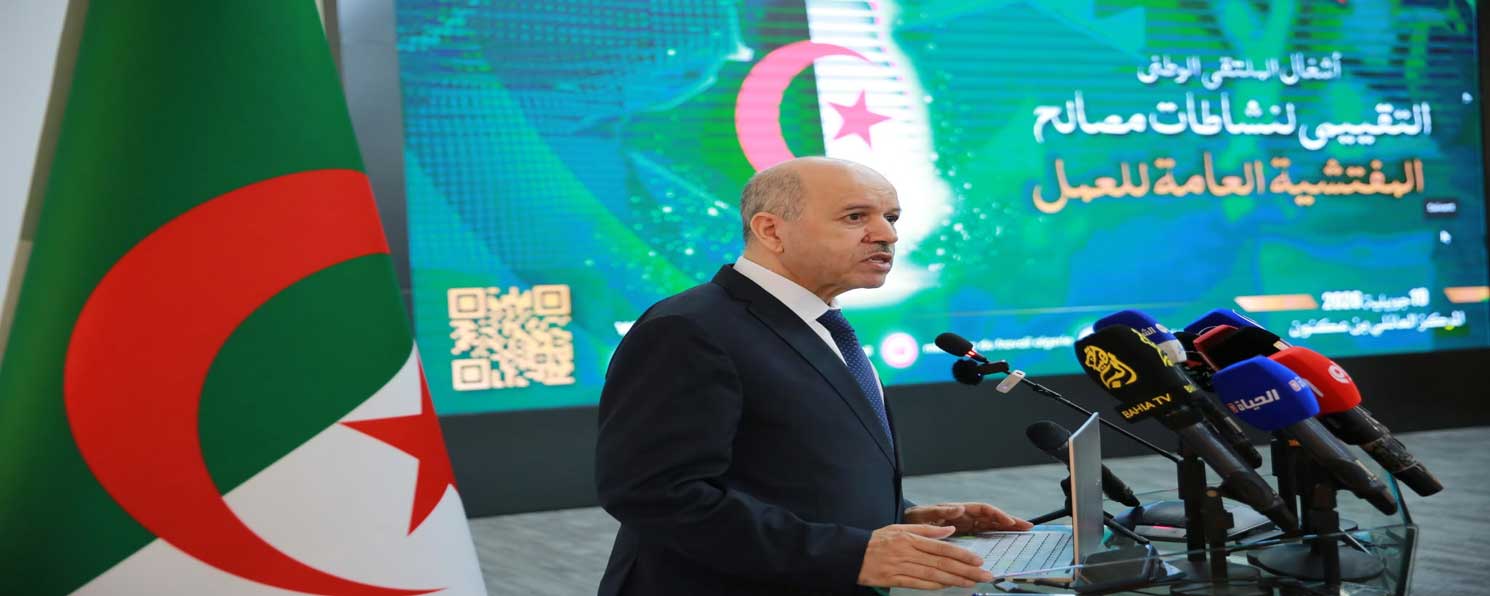
The Minister of Labour, Employment and Social Security, Mr. Abdelhak SAIHI, chaired, on Sunday, 19 July 2026, at the Ben Aknoun Conference Hall, the opening of the National Evaluation Meeting of Labour Inspectors, in the presence of senior officials from the central administration and regional labour inspectors, as well as provincial labour inspectors participating via videoconference.
In his address, the Minister commended the efforts made by labour inspectors in the field, stressing that the results achieved reflect significant momentum in the activities of the labour inspection body. He noted that more than 231,000 field visits covering over four million workers demonstrate the commitment to monitoring compliance with labour legislation and supporting economic enterprises. They also reflect a decline in the number of violations and an improvement in compliance with the legislation and regulations in force.
The Minister stressed that a labour inspector is not merely a law-enforcement or enforcement body, but also a partner and support to economic enterprises, playing a key role in guidance, advice and assistance, based on the principle of good faith. This approach makes it possible to improve compliance with the law and overcome difficulties related to the understanding or implementation of legal provisions.
The Minister emphasised that occupational health and safety constitute a strategic priority for the Labour Inspection Service, calling for the establishment of a genuine culture of prevention within enterprises and for efforts to reduce workplace accidents. He explained that approximately 80% of a labour inspector’s activities should be devoted to information, support and awareness-raising in the areas of prevention, occupational health and safety, before resorting to enforcement measures.
He highlighted that Algeria’s economic momentum, particularly in agriculture, public works, industry and other sectors, requires an approach based on support, guidance and clarification of legal and regulatory provisions, in order to ensure the protection of workers’ rights while supporting economic enterprises.
The Minister called for the adoption of accurate dashboards and performance indicators to measure the effectiveness of labour inspectors’ activities and link field programmes to clear and measurable objectives, thereby improving performance and achieving the desired results.
With regard to improving the conditions in which the profession is practised, the Minister stated that the Ministry is working to strengthen the resources made available to labour inspectors through the generalisation of digitalisation and the adoption of a continuous training policy focused on practical aspects, the improvement of working conditions, and the provision of the necessary prevention and protection equipment for field assignments.
The Minister also announced the launch of reform initiatives starting next September, including a review of the regulatory framework governing regional labour inspectors, with a view to upholding the principles of fairness and equal opportunity, as well as a review of the special statutory framework governing labour inspectors to bring it in line with the requirements of the current phase and contribute to improving public services.
Furthermore, the Minister explained that the economic transformations taking place in the country require the continuous updating of labour inspectors’ knowledge through the development of an intensive national training programme, to be implemented in coordination with the sector’s institutions, such as the Higher School of Social Security and the National Institute of Labour, while strengthening the exchange of expertise and openness to national and international experiences.
In the same context, the Minister announced the launch, as of 15 September 2026, of a training programme for labour inspectors from the Republic of Nigeria, as part of efforts to strengthen international cooperation and promote Algeria’s experience in the field of labour inspection. He called for the relevant educational programme to be prepared as soon as possible, whether through in-person training or videoconferencing.
The Minister concluded his address by stressing that the next phase requires maintaining the momentum achieved by the labour inspection body and strengthening its role in supporting economic enterprises, improving working conditions and promoting prevention, while contributing to economic and social development.
The Inspector General of Labour also delivered a presentation on the activity report of the General Labour Inspectorate for 2025 and the first half of 2026. The presentation reviewed various indicators relating to inspection activities, the enforcement of labour legislation, the promotion of occupational health and safety, as well as information and awareness-raising activities.
It should be noted that, during 2025, the inspection services carried out 231,296 inspection visits covering more than four (4) million workers across the various economic sectors. During the first half of 2026, 125,839 inspection visits were conducted, covering more than 1.9 million workers.
Inspection operations carried out during the first half of 2026 resulted in the issuance of 23,366 violation reports, 70,195 formal notices, and 19,214 written observations.
In the field of occupational health and safety, the inspection services issued 529 formal notices and 460 violation reports during 2025, compared with 294 formal notices and 330 violation reports during the first five months of 2026.
It should be noted that the Labour, Employment and Social Security sector continues to implement its programme to modernise the labour inspection body and strengthen its role in supporting economic enterprises, promoting prevention and improving working conditions. This reflects the State’s commitment to protecting workers, enhancing enterprise performance and promoting human capital as a key pillar for building a strong and sustainable economy.


